U/G · United Electric Service
Underground & overhead electrical installations
This is the work that goes in before anybody sees a light switch. Getting power from the utility to the building, and from the building to everything else on the property — underground in conduit, or overhead on poles. Get it wrong and it stays wrong, usually under concrete.
Underground
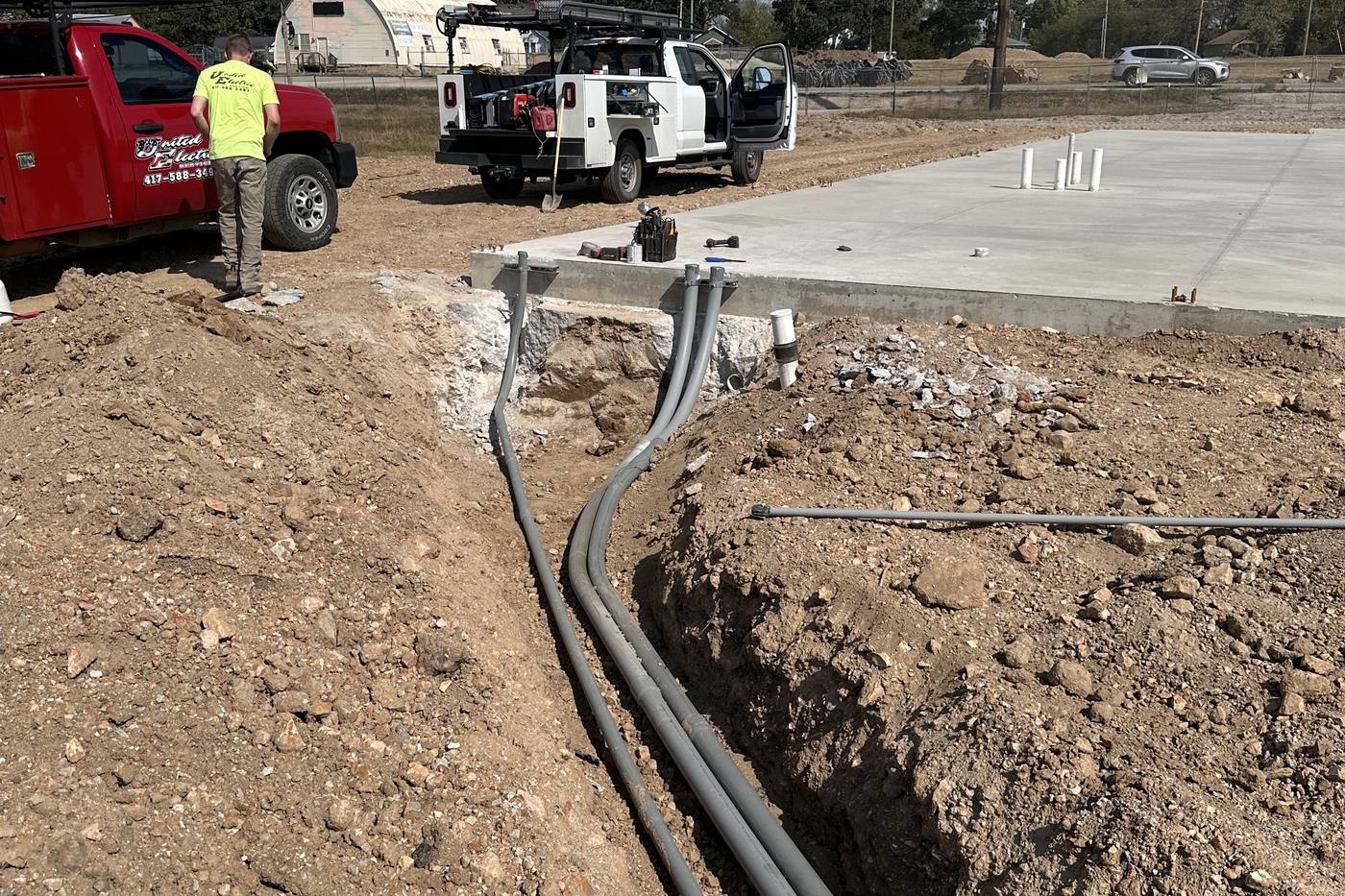
Trenched runs are permanent in a way almost nothing else in this trade is. Once the slab is poured and the lot is graded, what's in that ditch is what you live with. So we size conduit for the pull and for what gets added later, keep the bends inside what the wire can actually take, sleeve under drives and slabs before they go in, and bed and mark the trench so the next person with a backhoe has a fighting chance.
We do our own trenching. That matters more than it sounds — it means the ditch gets dug where the conduit needs to go, at the depth the code requires, instead of wherever somebody else's machine happened to be working that day.
Overhead
Poles, overhead services, and aerial runs between buildings. Masts and weatherheads, risers, and the coordination with the utility that has to happen before any of it gets energized. Overhead costs less than trenching and goes in faster, but it is exposed — which is why half our storm work is putting overhead services back after ice or wind took them down.
We will tell you honestly which one suits the job. A short run to a shop is usually overhead. A feed across a parking lot a customer will drive on is going underground, every time.
Contractor Information
- Owner
- Mike Evans
- Call
- 417-588-3497
- Hours
- Mon–Fri, 8:00 AM–4:00 PM
24/7 Emergency - Shop
- 250 W. Pierce St.
Lebanon, MO 65536 - License
- Missouri State Electrical Contractor
- Coverage
- Insured & bonded
- Dealer
- Cummins standby generators
Included
What this covers
- Trenching and backfill — our own machine, dug to code depth where the conduit needs to go
- Underground conduit and feeders — sized for the pull and for what gets added later
- Sleeves under drives and slabs — set before the concrete, not cored out after
- Service entrances — underground or overhead, coordinated with the utility
- Poles and aerial runs — between buildings, to shops, barns and equipment
- Masts, weatherheads and risers — including storm replacements
- Parking lot and site distribution — lighting, signage, gates and outbuildings
- Primary and secondary runs — to the point of the utility's connection
- Locating and marking — so the next excavation doesn't find your feeder the hard way
How It Goes
Common Questions
Questions about underground and overhead
How deep does underground electrical conduit have to be buried?
It depends on the conduit type, the voltage, and what's above it — the code sets different minimums for PVC versus rigid, for residential branch circuits versus a service feeder, and for runs under a driveway versus open ground. The practical answer is that it's deeper than most people expect, and an inspector will measure. We dig to what the job actually requires.
Is underground or overhead cheaper?
Overhead, usually, and it goes in faster. Underground costs more up front because somebody has to dig, but it's out of the weather, out of the way of equipment, and it doesn't come down in an ice storm. For a short run to a shop, overhead often makes sense. For anything crossing a drive or a lot, underground is worth the money.
Do you do your own trenching?
Yes. We run our own machine, which means the ditch goes where the conduit needs to go, at the right depth, on our schedule — not whenever a rented excavator and an operator happen to line up.
Can you run power to a shop, barn or outbuilding?
That's one of our most common jobs. We size the feeder for what you'll actually run out there, trench and set the conduit or run it overhead, set the subpanel, and wire the lighting, outlets and equipment inside.
Can you replace a service after storm damage?
Yes — masts, weatherheads, risers, meter bases and the overhead service itself. Storm work is 24-hour for us. More on emergency service.
Also From Us
Other services
24/7 emergency electrician
Power out, burning smell, sparking, storm damage — any hour, any day.
Read more RESResidential electrician
Tripping breakers, dead outlets, panel upgrades, new circuits, remodels.
Read more PNLElectrical panel upgrades & service changes
60 and 100 amp services and fuse boxes brought up to a modern 200 amp panel.
Read moreReady When You Are
Call and describe it.
You’ll get a person who does this work, not a call center. Mon–Fri 8 to 4, and 24 hours for emergencies.